
A salesperson picking up a sedan at Roissy on Monday morning to return it to Lyon on Friday evening does not manage their rental like a vacationer who takes a city car for a week in Crete. The constraints differ: long trips, return at a different agency, centralized billing, consideration in the fleet. Renting a car in a professional context requires mastering a few levers that general public guides do not address.
Professional rental and fleet tax: a link often overlooked
We rarely think about taxation when booking a vehicle for three days. However, the annual incentive tax on low-emission vehicles also applies to rented cars. Rented vehicles can be counted in the company’s fleet, pro-rata to their days of assignment.
In practice, a one-off rental is not neutral in the accounting. The perimeter rules and any exemptions vary depending on the duration and type of contract. Before confirming a reservation, it is advisable to check whether the chosen model increases or decreases the declared carbon footprint of the fleet.
This criterion encourages comparing offers not only based on the daily rate but also according to the fleet renewal schedule and the categories of vehicles available. To explore professional car rental on Carfully, you can access options filtered by engine type and emissions, which simplifies this selection process.

Test electric vehicles before equipping the entire team
Switching a fleet to fully electric without preparation means imposing an unsuitable tool on some employees. A field technician who makes multiple interventions in rural areas does not have the same charging needs as an executive commuting between two well-equipped metropolitan areas.
Short-term rentals allow testing electric vehicles on real trips before committing to a lease. You rent an electric vehicle for a specific travel profile (sales route, urban delivery, inter-site connection) and measure the effective range, charging time, and road comfort.
This approach avoids two common mistakes:
- Generalizing a vehicle model to the entire company when usage is heterogeneous, between the regional salesperson and the maintenance technician.
- Giving up on electric vehicles after a single unrepresentative test, such as a highway trip of over 400 km without prior identification of charging stations.
- Underestimating the impact on daily organization: adapting tour schedules to charging times changes work habits.
The Ministry of Transport and ADEME have also launched a call for expressions of interest to experiment with car-sharing for company vehicles. The principle: pooling cars among employees and, in the evening or on weekends, opening them to other users. Pooling reduces the number of vehicles needed and accelerates the return on investment for a more expensive electric model.
Professional rental contract: clauses that change the bill
In professional rentals, the standard contract often hides cost items that are not negotiated enough. The deductible in case of damage, the mileage cap, and the return fees at a different agency from the departure point are the three lines that can double the bill.
Deductible and additional insurance
Liability insurance is included in every rental contract in France. However, damage coverage almost always leaves a deductible for the renter. For professional use with multiple drivers, checking if the company credit card covers the deductible before taking out additional insurance with the rental company can represent significant savings.
Mileage and fuel
Unlimited mileage packages are not always truly unlimited: some contracts cap at a daily threshold beyond which each kilometer is charged extra. For salespeople covering long distances, this detail can turn an attractive offer into a bad deal.
On the fuel side, the return policy varies. Returning the vehicle with a full tank avoids penalties, but some agencies charge for fuel at a rate higher than the station price. You save time by locating the nearest station to the return point before departure.
Condition report and return: protecting the company
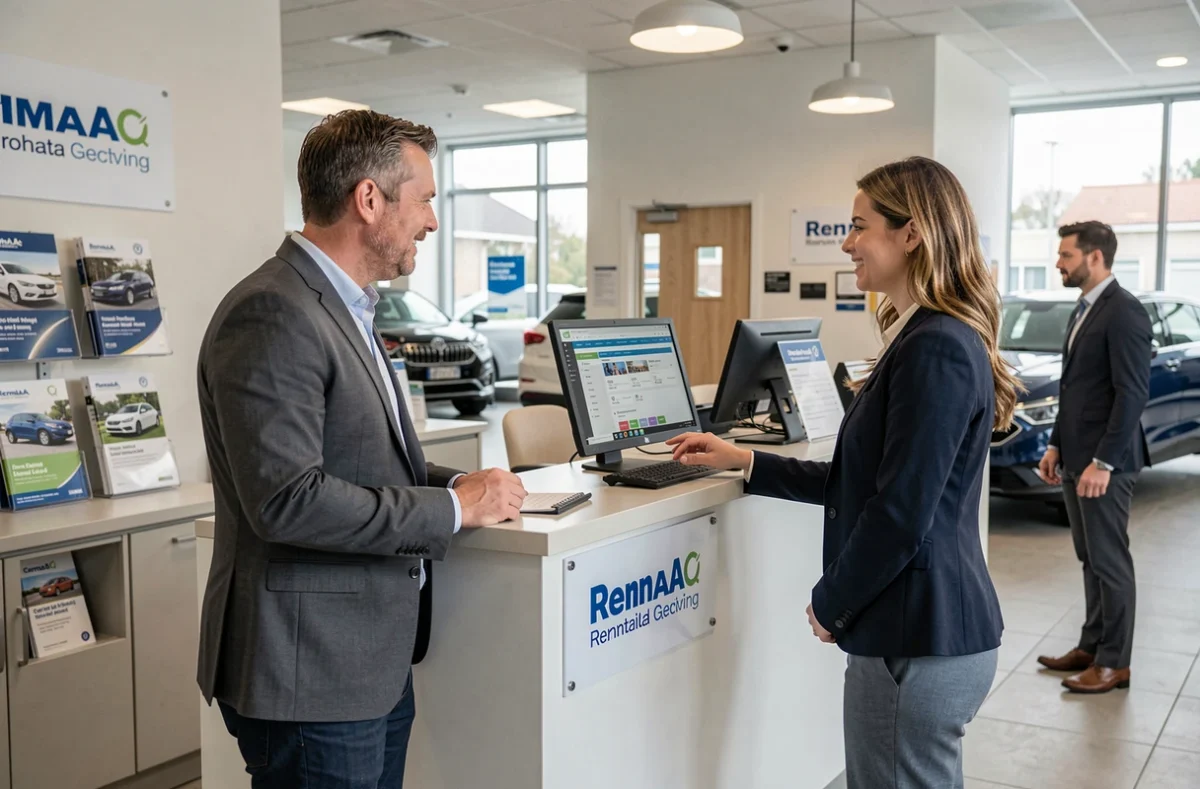
The contradictory condition report is the only document that protects the renter against abusive billing for pre-existing damages. In a professional context, the employee picking up the vehicle is not always the one returning it, complicating tracking.
- Photograph the vehicle from all angles at the time of pickup, including the odometer and fuel level.
- Report in writing on the departure form every scratch, dent, or defect noted, even minor ones.
- Request a signed document from the agent upon return confirming the absence of new damage or detailing any damages observed.
A photographed and signed condition report at both ends of the contract cuts short any dispute. If the employee returns the car outside of opening hours (key drop-off in a box), it is even more necessary to document the vehicle’s condition before leaving.
Disputes over the condition of the return represent the most common source of friction between companies and rental agencies. Implementing a simple internal procedure (three photos, a shared form) reduces risk without burdening the process. Renting a car for professional use becomes smoother as soon as each step, from booking to return, follows a clear protocol shared with the entire team.