
You’re planning to redecorate a room or an entire home with pieces designed specifically for your space. Before choosing a color or fabric, the first question is how much to budget for your bespoke interior design project.
Setting a budget involves more than adding up the cost of the furniture. You also need to account for expenses that are often underestimated, such as VAT rates that vary depending on the type of expense and costs associated with changes made during the project.
Bespoke or adapted furniture: the choice that determines your decorating budget
Having a bookcase made to fit the exact dimensions of your alcove costs more than buying a standard piece of furniture. But adapting an existing piece doesn’t always save as much as you might expect.
Take a sideboard picked up at a flea market. The purchase price is attractive. Then add transport (sometimes charged according to volume and distance), restoration (sanding, lacquering, replacing hardware), and cutting it to fit your wall. These combined costs can exceed the price of a piece made to measure to fit the space perfectly from the outset.
The reverse is also true: a well-made standard sofa that fits your living room as it is doesn’t need to be custom-made. Make the decision room by room, comparing two complete quotes that include transport and finishes.
To estimate a budget for a bespoke interior design project, list every element of the project and decide whether custom manufacturing offers a real advantage over adapting an existing product.
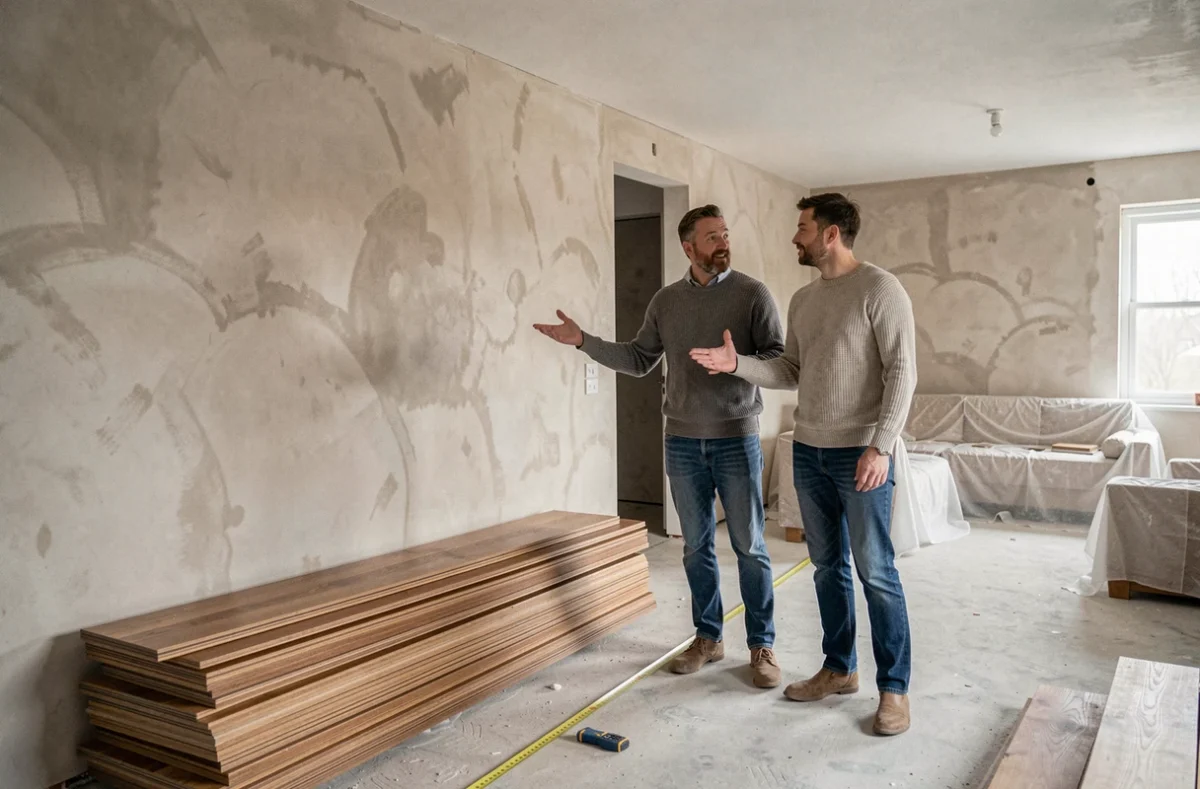
Interior design expenses: identify the costs that really add up
Not all expenses have the same impact on your decorating budget. Some account for most of the total, while others are negligible. Focusing on the three or four biggest expenses saves you from wasting time negotiating marginal savings.
The main expenses
- Custom furniture (joinery, upholstery, cabinetmaking) is often the biggest expense. The price depends on the material, the complexity of the design, and the number of finishes required.
- Renovation work (painting, wall coverings, recessed lighting) is usually the second-largest expense. The cost varies according to the area and the condition of the surfaces.
- Professional fees (interior architect, interior designer) are a separate expense. There is no official fee scale: fees are freely negotiated and depend on the scope of the work, the complexity of the space, and the overall cost of the project.
- Transport and delivery of bulky or fragile items, often overlooked in initial estimates, can add several hundred euros to the total.
Comparing professionals’ quotes
Rather than comparing fee percentages alone, look at what each quote includes. The stages covered matter more than the percentage shown: design, contractor consultations, site supervision, and project handover. A cheaper quote that excludes site supervision leaves you to handle unexpected issues on your own.
VAT and bespoke interior design: rates vary by expense
You may have heard that renovation work qualifies for a reduced VAT rate. In practice, the rules are more nuanced than that general principle suggests.
The VAT rate depends on the type of expense, not just the age of the property. For work on a home completed more than two years ago, the rate may be 10%. For eligible energy-efficiency renovations, it drops to 5.5%. However, furniture and equipment purchased directly by the client remain subject to the standard rate.
In practice, a single interior design project may involve three different VAT rates:
- Installation of a wall covering by a contractor in an older home: a reduced rate may apply.
- Purchase of a designer light fixture that you order yourself online: standard rate.
- Insulation work included in the renovation: reduced rate, subject to conditions.
Separating labor, materials, and furniture in your budget helps you avoid underestimating the total cost, including VAT. Ask your professional to break down the quote by type of expense. Under certain conditions, the reduced-VAT certificate has now been replaced by a certification included directly on the quote or invoice. Ask for clarification when requesting a quote, and keep copies of the documents for five years.

Budgeting for unexpected costs and changes during an interior design project
A bespoke interior design project almost always evolves between the first sketch and final delivery. You change your mind about a fabric, a technical constraint comes to light behind a partition, or a contractor suggests an alternative.
Any change made during the work can lead to additional costs. Putting the process for approving changes in writing helps prevent unpleasant surprises. The initial quote should explain how adjustments will be charged: at an hourly rate, through a contract amendment, or within a pre-agreed allowance.
Setting aside a contingency fund from the outset is the best protection. This financial cushion lets you absorb unexpected costs without compromising the entire project.
What the quote should include
In addition to the total price, check that the quote specifies the timeline, the terms for making changes, and any items that will be charged extra. A detailed quote protects both the client and the professional. If any item is unclear, ask for it to be reworded before signing.
Setting a budget for a bespoke interior design project means mapping out every expense, weighing custom manufacturing against adapting existing pieces, and accounting for VAT variations and changes along the way. A well-costed project from the outset leaves room for creativity without putting your finances under strain.