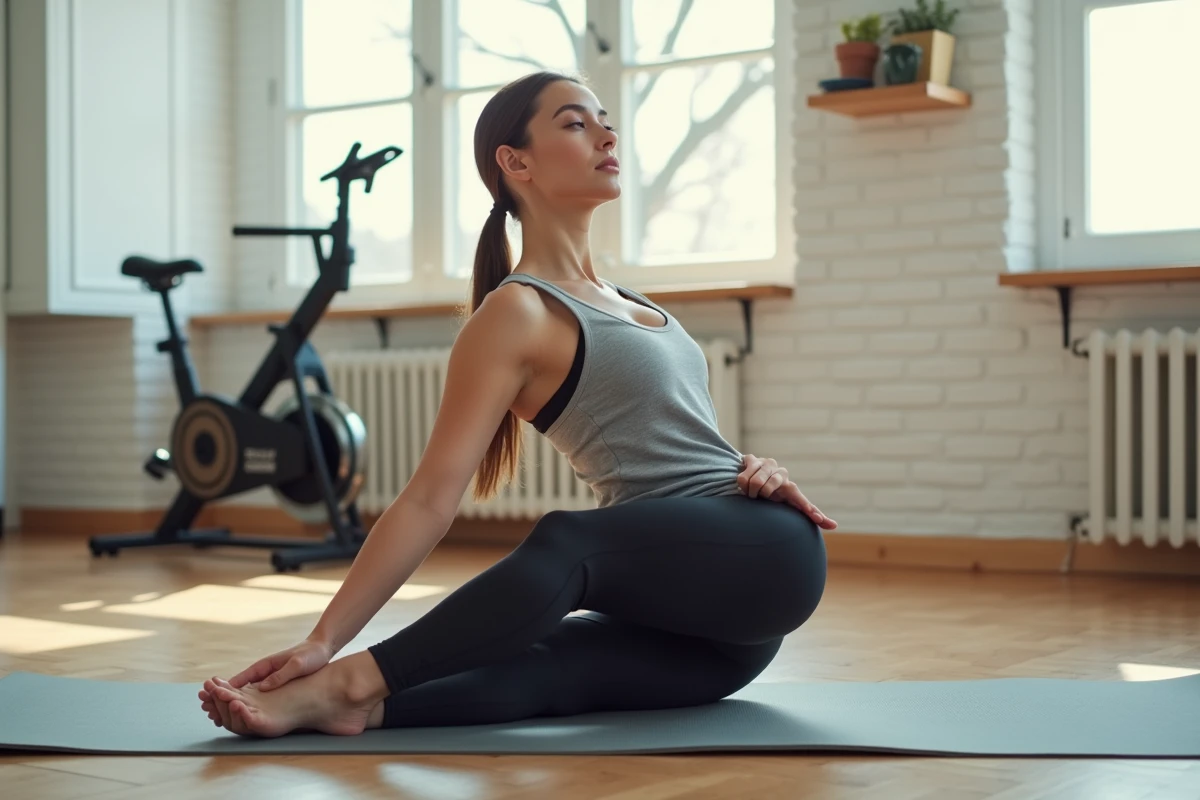
After a session on the stationary bike, the leg muscles remain contracted in a reduced range. Pedaling primarily engages the quadriceps, hamstrings, and calves, but in a cyclical motion that never fully stretches them. Practicing targeted stretches after exercise helps restore muscle length and limit stiffness that sets in during the following hours.
Why the stationary bike shortens certain muscles
The pedaling motion keeps the body in a flexed position. The hips never fully open, the knees remain in constant flexion, and the torso leans forward. This prolonged posture causes a shortening of the hip flexors, particularly the iliopsoas.
The quadriceps and hamstrings work in rapid alternation without ever reaching their maximum elongation. Over a session lasting several tens of minutes, this repetition creates residual tension in the muscle fibers.
The lower back compensates for the seated position by locking up. The lumbar muscles stiffen to stabilize the pelvis on the saddle. This phenomenon explains why lower back pain sometimes appears after training, even though the stationary bike is considered a low-impact joint exercise.
Taking the time to focus on stretches after cycling helps understand which muscle groups require special attention based on the duration and intensity of the effort.
Leg stretches after cycling: quadriceps, hamstrings, calves
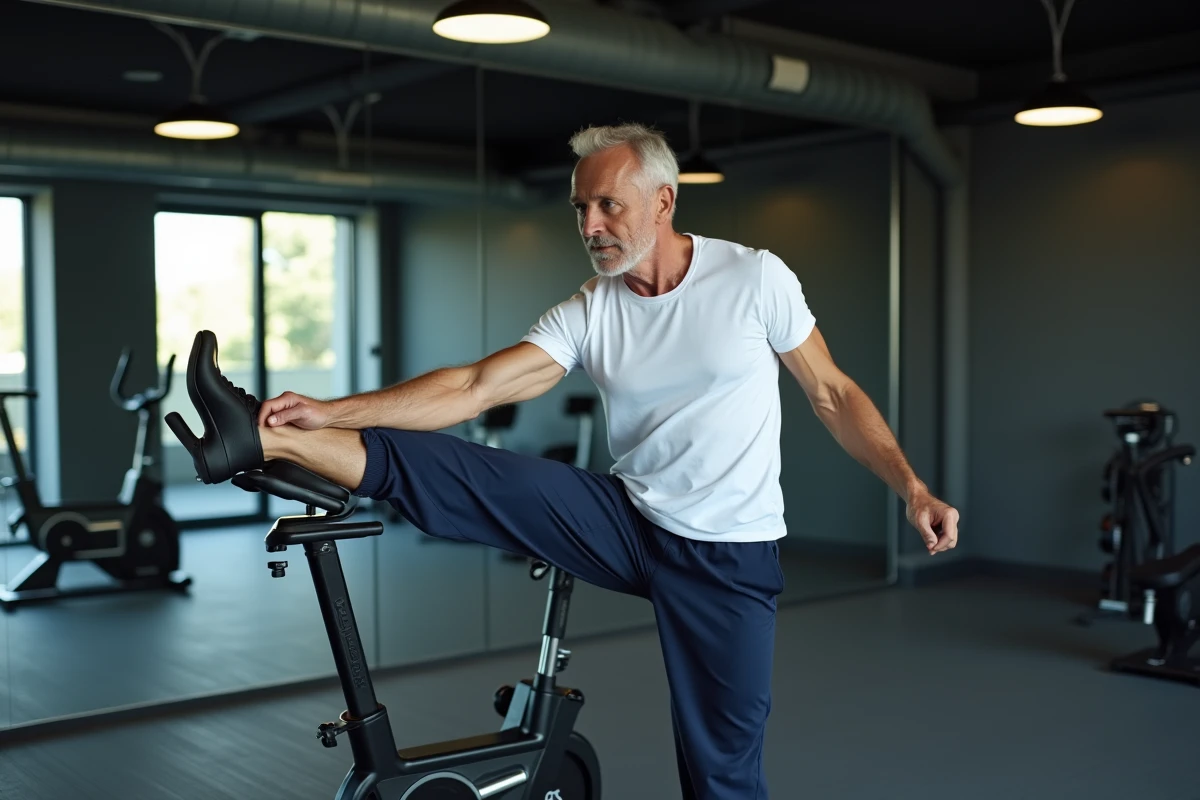
These three muscle groups bear most of the effort during pedaling. Stretching them in order, from the largest to the smallest, follows a logic of progressive recovery.
Quadriceps
Standing, foot pulled towards the buttock, knee pointed towards the ground. The hand grabs the ankle (not the foot from above). The pelvis remains neutral, without arching. Holding the position for about thirty seconds per leg is enough to release the accumulated tension in the front of the thigh.
A common mistake is pulling the heel towards the buttock while allowing the knee to move to the side. This movement engages the hip more than the quadriceps and loses effectiveness.
Hamstrings
With one leg extended on a low support (step, stool), the torso leans forward while keeping the back straight. The sensation of stretching should be felt at the back of the thigh, not behind the knee. If tension appears behind the knee, the support is too high or the leg is locked in hyperextension.
Calves
Facing a wall, one leg forward bent and the other back straight, heel on the ground. The calf stretches effectively when the heel remains pressed to the ground throughout the exercise. Slightly leaning the torso towards the wall increases the intensity without forcing.
Stretches for the psoas and hip flexors after exercise
The iliopsoas is the muscle most affected by prolonged sitting on the stationary bike. Its chronic shortening pulls the pelvis forward and accentuates lumbar curvature.
The low lunge is the most direct exercise to target it. One knee on the ground, the other leg forward at a right angle, the torso remains vertical. The pelvis gently slides forward until a deep stretch is felt at the front of the back hip.
- Keep the torso upright without leaning forward, which cancels the stretch of the psoas
- Lightly contract the abdominals to prevent the pelvis from tilting forward
- Alternate both sides without rushing, maintaining the same duration for each leg
- Add a slight rotation of the torso towards the opposite side of the back leg to intensify the work on the psoas
This single exercise targets the psoas, the rectus femoris, and the hip joint capsule. It directly compensates for the closed posture imposed by pedaling.
Stretches for the back and upper body after a session
The stationary bike does not only engage the legs. The upper body suffers the consequences of the posture maintained during the session, especially in the lumbar region, mid-back, and shoulders.
Lumbar and posterior chain
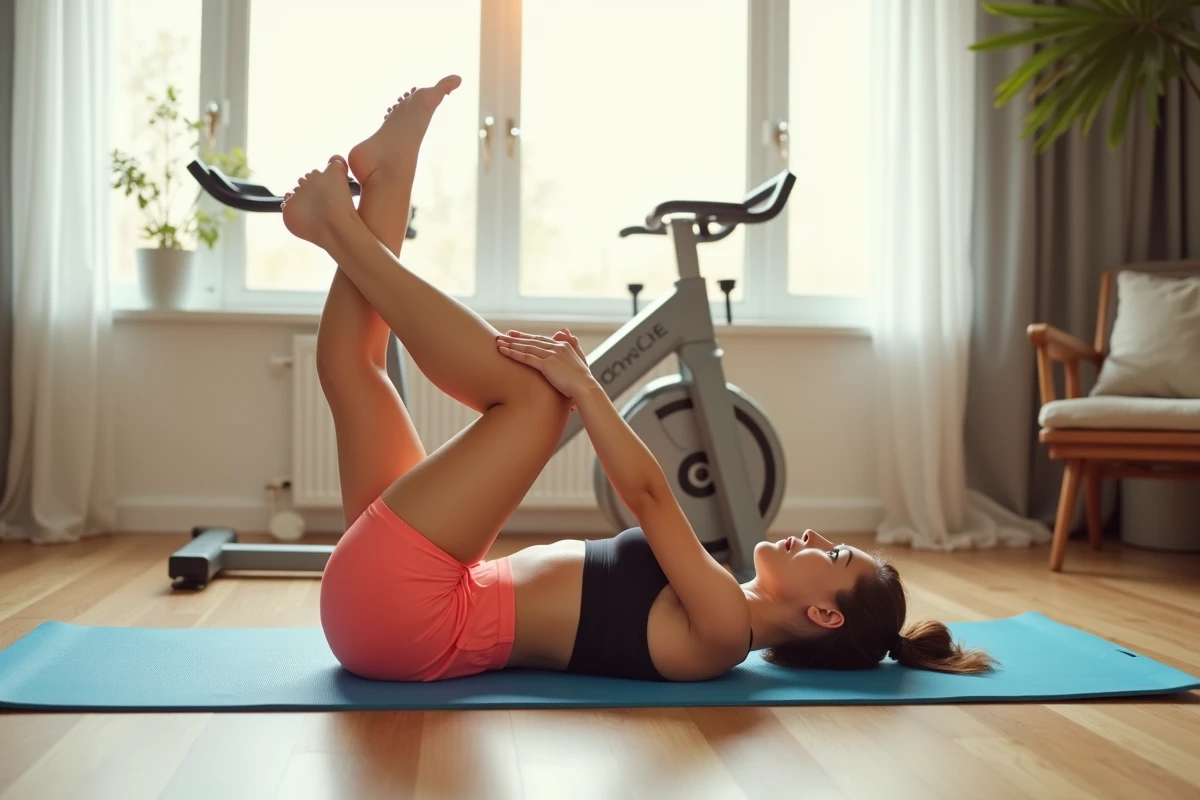
Lying on the back, bring both knees towards the chest and hold them with the hands. This position rounds the lower back and decompresses the lumbar discs stressed by the seated position. Staying in this posture for a few deep breaths enhances relaxation.
Shoulders and upper back
Arms crossed in front of the chest, the other hand pulls the elbow towards the opposite shoulder. The trapezius and posterior deltoid relax. This simple gesture corrects the tension accumulated from gripping the handlebars, especially on bikes with a forward-leaning sporty position.
The neck also deserves a few seconds of attention. Slowly tilt the head to one side, ear towards the shoulder, without raising the opposite shoulder. The neck muscles contract to stabilize the gaze during pedaling and remain tense long after the exercise ends.
Muscle recovery: beyond stretching
Stretching is just one part of recovery after a session on the stationary bike. Hydration plays a direct role in muscle flexibility. A dehydrated muscle loses elasticity and responds less effectively to stretching.
- Drink water regularly in the hour following the session, in small sips rather than large amounts at once
- Walk for a few minutes after cycling to gradually bring the heart rate back to rest
- Avoid sitting immediately after exercise, which closes the hips in the same position as on the saddle
The quality of recovery also depends on the timing of the stretches. Practicing them in the minutes following the end of pedaling, when the muscles are still warm, improves their effectiveness. Waiting several hours reduces the muscle fibers’ response to elongation.
A regular stretching program, repeated after each workout on the stationary bike, gradually changes the flexibility of the most engaged muscle groups. The first sessions may seem limited in range. Consistency matters more than the intensity of each stretch.