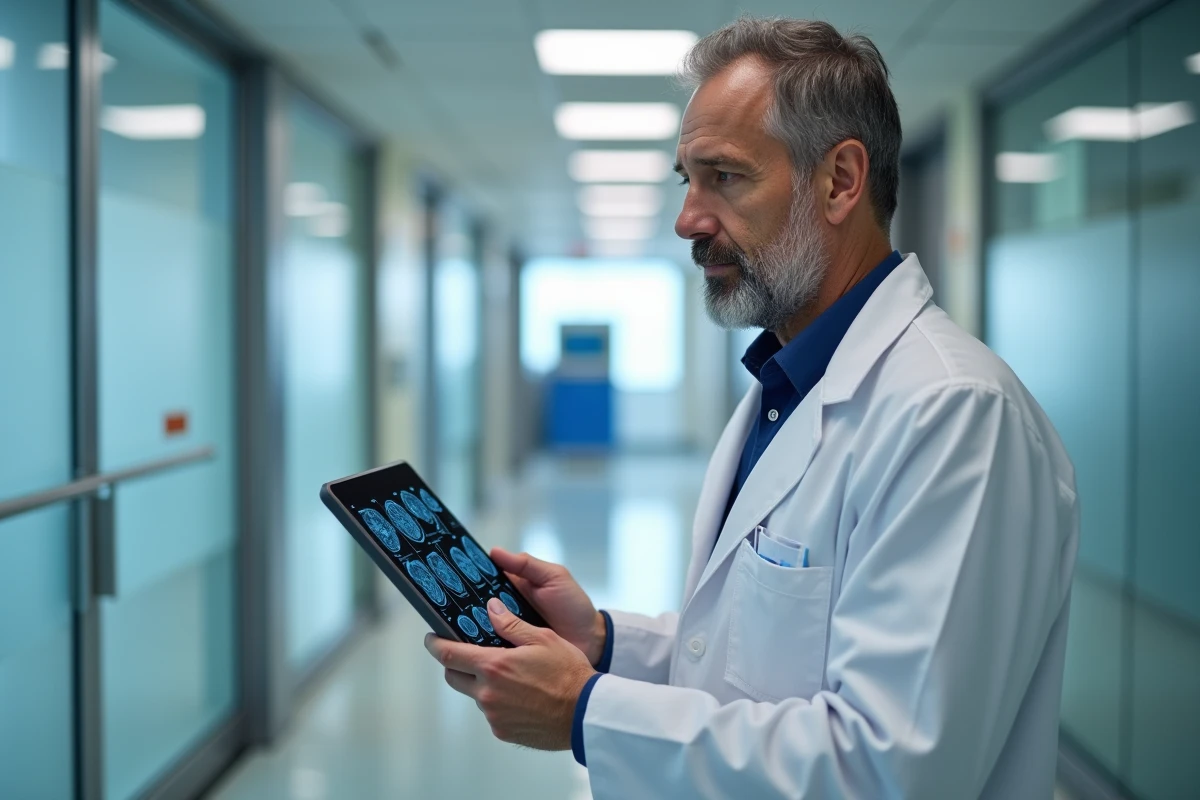
Xavier Morandi has been practicing neurosurgery at the CHU de Rennes since the mid-1990s. Born in Pontivy in 1963, he has built a dense hospital-university career focused on surgical neuroanatomy and imaging-guided surgery. A University Professor and Hospital Practitioner since 2005, he has been leading the neurosurgery department at the CHU de Rennes since 2011.
Awake Surgery and Imaging Navigation at CHU de Rennes
Awake surgery for the resection of brain tumors is one of the most technical operational axes of the department led by Morandi. This approach requires keeping the patient conscious during the resection to map the functional areas of the cortex in real-time, particularly the language and motor areas.
At the CHU de Rennes, immersive reports have documented these interventions, showing how direct cortical stimulation guides the surgical gesture millimeter by millimeter. The neurosurgeon communicates with the patient during the operation, adjusting the resection based on motor and linguistic responses, thereby reducing the risk of postoperative neurological deficits.
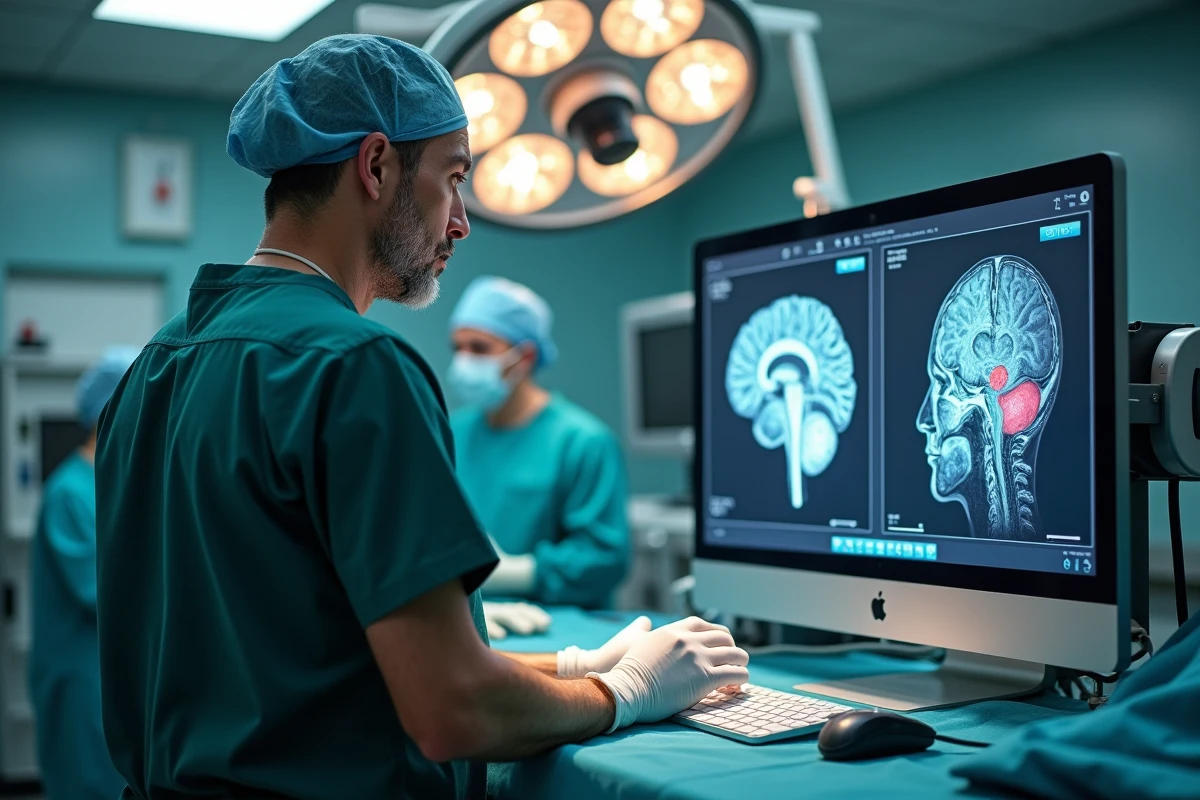
Morandi is also a permanent member of the MediCIS team (Inserm, UMR 1099 LTSI), a research laboratory focused on medical image processing and surgical simulation. This affiliation is not honorary: it directly feeds into the protocols of imaging-guided neurosurgery used in the operating room. The three-dimensional modeling of vascular and tumor structures, before and during the intervention, allows for safer surgical trajectory planning.
To consult reviews on Xavier Morandi in Rennes, several platforms compile feedback from operated patients, particularly regarding the clarity of postoperative explanations.
Training of Neurosurgery Interns: Morandi’s Role in National Selection
Beyond surgical practice, Xavier Morandi holds a structuring position in French medical training. He has served as a recurring jury member for the national ranking exams (ECN) in neurosurgery, a role that directly influences the profile of future interns entering the specialty.
Participating in the ECN as a jury shapes the discipline at the national level. The selected clinical cases, grading scales, and assessed competencies guide the selection towards more or less surgical profiles, more or less research-oriented. Morandi brings a dual expertise to these committees: that of the surgeon and that of the academic anatomist.
His academic background distinguishes him in this field. Authorized to supervise research since 2003, vice-dean of the Faculty of Medicine of Rennes between 2009 and 2013, and then president of its Scientific Council, he has held governance positions that extend beyond the hospital service framework.
A Stint at McGill University
Morandi undertook a scientific mobility of twelve months at McGill University in Canada in 2000. This stay at one of North America’s leading neuroscience centers preceded his authorization to supervise research. Exposure to Anglo-Saxon research protocols, more focused on translational medicine, enriched his later work on neuroanatomy applied to surgery.
Surgical Spectrum: Spinal and Cerebral Vascular Pathologies
Xavier Morandi’s intervention field covers two main axes, often treated by distinct subspecialists in other centers.
- Craniocerebral and vascular surgery: management of cerebral aneurysms, intracranial tumors, and pathologies requiring in-depth preoperative neurological functional exploration.
- Spinal surgery: disc herniation, lumbar canal stenosis, spondylolisthesis, cervical-brachial neuralgia. These interventions represent a significant part of the department’s activity and involve patients often referred after conservative treatment failure.
- Vertebroplasty: a percutaneous technique for vertebral consolidation, used in osteoporotic fractures or pathological compressions. This minimally invasive approach reduces hospitalization duration compared to open surgery.
This broad spectrum requires a team trained in very different techniques, from the operating microscope for intracranial surgery to intraoperative fluoroscopy for spinal procedures. The versatility of the neurosurgery department at CHU de Rennes partly relies on this dual cranial and spinal expertise.

Scientific Publications and Clinical Research Involvement
Xavier Morandi is the author of over 140 international publications in peer-reviewed journals, a volume that places him among the most published French neurosurgeons. His work primarily focuses on surgical neuroanatomy, which is the study of anatomical relationships exploited during surgery.
Research in neuroanatomy does not aim for fundamental discovery but rather for the safety of the surgical gesture. Mapping vascular variants, atypical nerve pathways, and the relationships between tumors and functional structures helps reduce perioperative complications. This type of research, less publicized than therapeutic trials, has a direct impact on daily practice in the operating room.
Affiliation with the LTSI laboratory (Signal and Image Processing Laboratory) of Inserm directs some of these publications towards interventional imaging and simulation. We observe that this connection between imaging research and neurosurgical practice remains rare in comparable French CHUs.
Convention and Access to Care
Morandi practices in sector 1, with coverage by Social Security and full third-party payment (Social Security and mutual insurance). This choice of convention, increasingly uncommon among specialist surgeons in hospital-university settings, ensures the absence of excess fees for patients referred to the CHU de Rennes.
The neurosurgery department is located at 2 rue Henri Le Guilloux, on the main site of the CHU. Consultations require a referral from the attending physician or a specialist, in accordance with the coordinated care pathway.