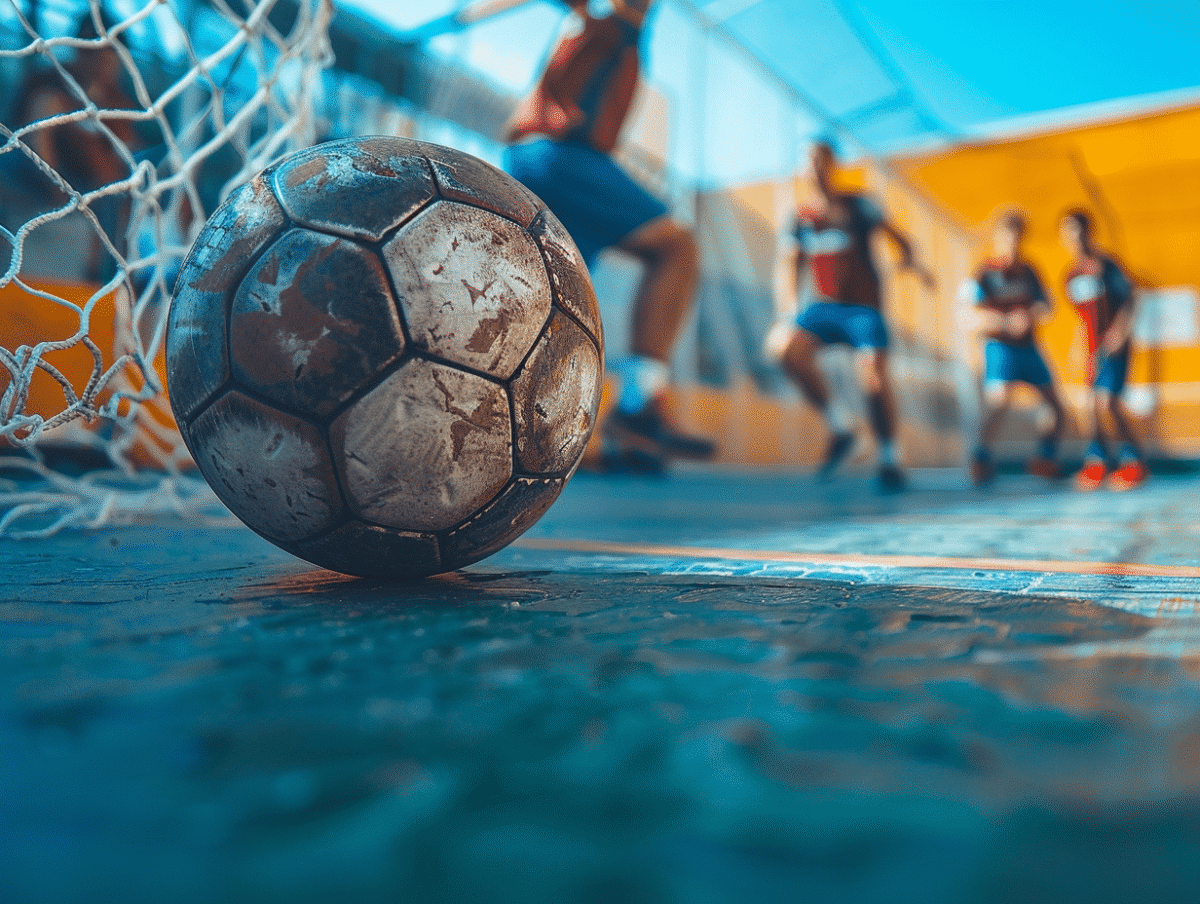
Handball is characterized by its dynamism and speed, a team sport played seven against seven. Each player must be equipped with suitable indoor shoes and a jersey corresponding to their team. The rectangular court measures 40 meters long by 20 meters wide, marked by clearly visible lines. The goals, located at each end, are defended by the goalkeepers, the only players allowed to touch the ball in the goal area. Mastery of the fundamentals, the rules of the game, and respect for the opponent are essential for practicing this intense sport.
The essential rules for playing handball
Knowledge and application of the rules of handball form the foundation of practicing this team sport. The dimensions of a handball court are crucial: 40 meters long by 20 meters wide, with a goal area extending 6 meters on each side of the goal. The penalties in handball are codified and strictly enforced for any infraction, ranging from a yellow card to temporary or even permanent exclusion with a red or blue card.
For the flow of the game, the free throw is a fundamental rule for resuming play after a minor foul. It must be executed at the spot where the infraction occurred, with opponents standing three meters away from the player taking the throw. A team’s effectiveness greatly depends on its ability to capitalize on these moments. The goalkeeper plays a crucial role, being the only one allowed to intervene in the goal area and to use their feet within their own area.
Respecting the court lines is also fundamental. The goal line marks the boundary that the ball must cross for a goal to be validated, while the center line divides the court into two equal zones. The International Handball Federation (IHF) ensures the uniformity of the rules and their evolution, thus maintaining the integrity and continuity of this sport on a global scale. Follow these guidelines, and the court becomes a space for competition and fair play, where teamwork and strategy meet for the enjoyment of both players and spectators.
From equipment to the court
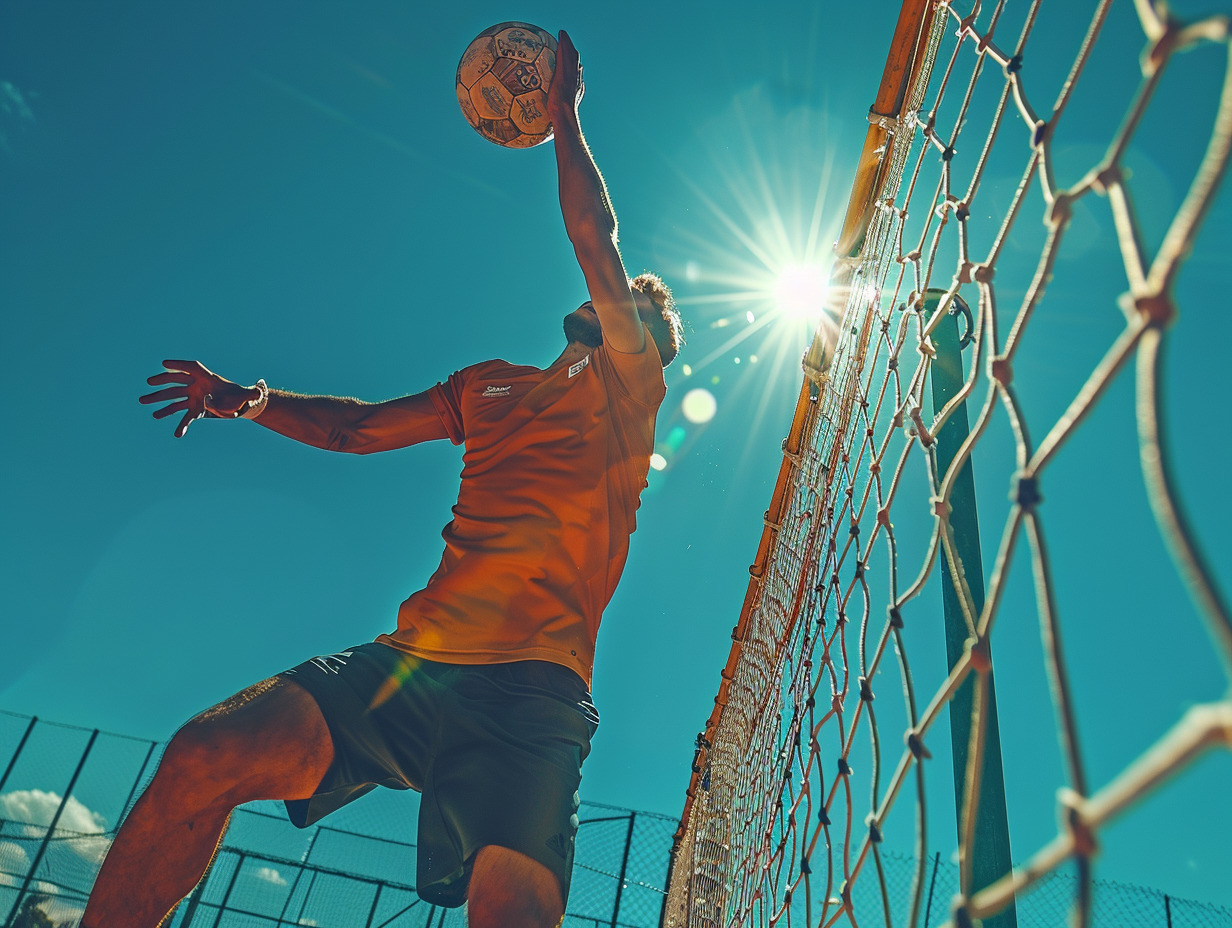
The handball equipment is as diverse as it is functional, suited to the intensity of the sport. Each player, from the goalkeeper to the wingers, is equipped with non-slip shoes, lightweight shorts and jerseys, as well as knee pads to protect them during dives and defensive slides. The ball, a central element, varies in size and weight according to age and gender categories, in accordance with the specifications of the International Handball Federation (IHF).
On the handball court, every detail matters. The lines that define it are not just visual markers but active elements of game strategy. The center line separates the two halves, while the 9-meter lines, marking the area for executing free throws, are essential for the proper conduct of game phases. The regulatory size, defined by the IHF, ensures uniformity for all teams worldwide.
The handball team consists of seven players, each with specific roles and skills to master. Field players must excel in the basic handball techniques: accurate passing, powerful shooting, and skilled receiving to ensure the fluidity and effectiveness of the game. The team’s cohesion depends on the synergy between these individual skills.
The training and ranking of teams are based on relentless rigor, refining techniques and strengthening team spirit. The IHF dimension for teams places training within a formal framework, promoting fairness in competitions and allowing each player to measure up to international standards. Mastery of equipment and knowledge of the court remain pillars for any training aspiring to excellence in the field of handball.